Want an email when this course is scheduled in your province? expand_more
Tyre changing and tyre pressure monitoring systems (TPMS): servicing
cars timer 1-day course assignment certificate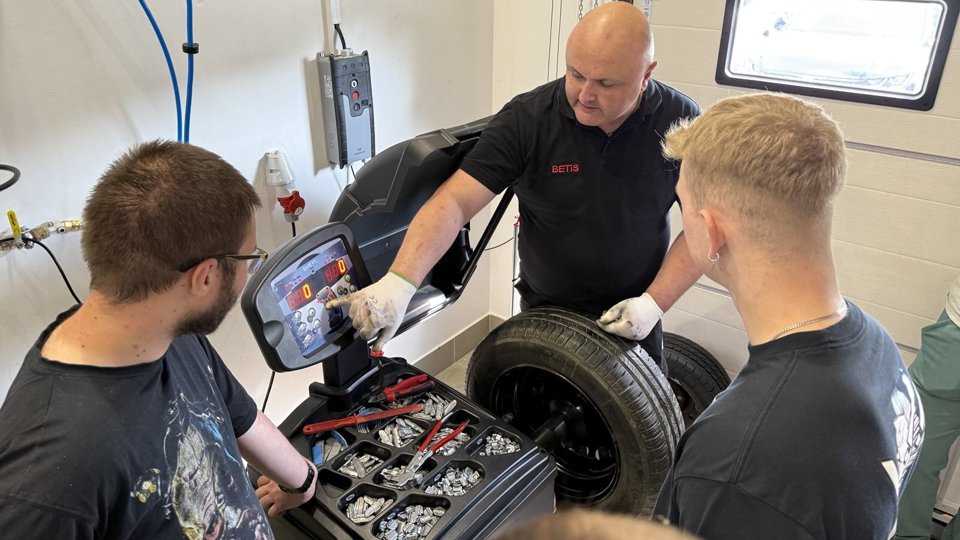
Course overview:
Changing and balancing tyres is one of the most basic servicing jobs on any car. Yet many mechanics don't do it efficiently or entirely correctly.
On this course we teach you to change and balance tyres quickly, simply and correctly, without risking damage to the tyre, the alloy wheel or the TPMS sensor (low-profile and run-flat tyres included).
On this course:
- learn how tyres for cars and vans are built and what types there are, including how to choose the right tyre for the vehicle and the driving conditions
- find out how differences in tyre type and construction affect the way a tyre behaves on the vehicle
- learn to change tyres with and without TPMS sensors quickly and without risk of damaging the tyre, alloy wheel or sensor
- find out how to check tyres for damage, how to identify the likely causes of abnormal wear and when a tyre can be repaired
- learn the key steps in tyre fitting and which types of tyre cause the most trouble
- learn to balance wheels after fitting tyres
- learn to assess the condition of tyres and whether they are still fit for use
- learn to fit even the lowest-profile tyres correctly without damaging them, and to balance them properly and effectively
- find out what electric vehicles demand of their tyres
- learn a great deal about TPMS (Tyre Pressure Monitoring Systems)
- get to know the tools for programming DD (Direct Detection) TPM sensors
- the types of TPMS
- how to calibrate them
- how to program them (pair them with the vehicle)
- how to diagnose wheel-mounted pressure sensors
Course outline:
- Tyre and wheel rim types, requirements and markings
- Tyre and wheel markings
- Tyre maintenance before seasonal tyre storage
- Low rolling resistance tyres and tyre criteria for different vehicle types
- Tyre fitting
- Checking the tyre for damage
- Fitting TPMS sensors to the wheel rim
- Fitting a tyre with and without a TPMS sensor, including wheel balancing
- Types of tyre damage and their causes
- TPMS types and their features
- Differences between the systems in use
- Calibrating passive systems
- Antennas and control units used for TPMS servicing
- Sensor types and how to choose them
- Software updates for programming tools: TPMS Connect Evo Magneti Marelli, SENSOR AID by CUB
- Hands-on use of programming tools: TPMS Connect Evo Magneti Marelli, SENSOR AID by CUB
- Programming sensors for different cars, on the wheel and before fitting to the wheel
- TPM sensor diagnosis
- Automatic sensor cloning
- Manual sensor cloning
- Programming new sensors without a sensor ID
- Programming a new set of wheels with additional IDs
- Sensor ID database for supported cars
- Manually changing sensor IDs in a sensor fitted to the wheel
- TPMS diagnostics
- Analysing fault codes and complete reports on servicing problems
Requirements:
- there are no special requirements for this course
Price (excl. VAT):
- 700 PLN
KFS funding (National Training Fund): usually 70-90% of the price of in-person and online courses
You can get funding from the Krajowy Fundusz Szkoleniowy (National Training Fund, KFS for short) through your Powiatowy Urząd Pracy (PUP, the local job centre). It is open to employers, their employees and contractors, and to self-employed people with no staff. The condition is that contributions to the Fundusz Pracy (Labour Fund) have been paid for at least 6 months before you apply (or that you are exempt from paying them by law).
To get funding, call the Powiatowy Urząd Pracy for the area where your business is registered (list of district labour offices in Poland) and find out:
- whether KFS funding is available (and if not, when it can be expected)
- whether there is an approximate amount available per employee
- how to get the funding
- by when the course must take place
- by when the quote and the application must be submitted
The funding application must be filled in and sent online, from an account on the praca.gov.pl portal. Our quote must be attached to it. Once you have sent all the documents, we suggest calling the office to ask when it will decide on your application. If the application is approved, you will be told by email or someone will phone you (this depends on the job centre).
Once your application has been approved, just give us a call: we will confirm the date and the details of the course.
BUR funding (Development Services Database): usually 50-80% of the price of in-person and online courses
Funding is available in every province for micro, small and medium-sized businesses and their employees, and for private individuals, when they sign up for a course through the Baza Usług Rozwojowych (BUR).
If you already have a BUR account, you can go straight to the search page and sign up for the course you have chosen.
If not, you will find some helpful information below.
Each province (or, more precisely, its operator) decides for itself who can get funding, how much and when it accepts applications, but there is a general procedure to follow.
- Go to the funding section of the BUR website and, under "Programy regionalne" (regional programmes), choose the province where your company is registered or, if you are a private individual, where you study or live.
- Find the operator for your area, call them and ask how to get funding. You will certainly need to:
- sign an agreement with the regional operator,
- create an account in the BUR.
- Sign up for the course through the BUR, quoting the "ID Wsparcia" (support ID) number agreed with the operator.
- If the course you are interested in is not scheduled in the BUR, call us on (+48) 510 566 088 and tell us which course you would like to sign up for. We will set a course date and schedule it in the BUR.
Anyone who meets the conditions set by the operator in their province can get funding, until the regional operators run out of the EU funds allocated to them.
The content is tailored to the needs of each group.
The topic, content, scope, individual parts and format of this course are protected by copyright under the Polish Act of 4 February 1994 on Copyright and Related Rights (ustawa o prawie autorskim i prawach pokrewnych, Dz. U. Nr 24 poz. 83).
Upcoming courses
No courses scheduled.